The development of rural communities is recognized as one of the priorities in the countries of the European Union, with special emphasis on the important role of citizens in meeting the needs of rural areas and marginalized groups that live in them.
The Institute for Development and Innovation, through the Horizon Europe project ESIRA (Enhancing Social Innovation in Rural Areas), is part of a consortium of 15 partner organizations from eight countries. The goal of the work is to contribute to the development and implementation of innovative initiatives that come from rural areas, which will improve the position of individuals from vulnerable groups on the labor market.
The development of rural communities can only be affected if all relevant actors are involved, both from the local and national level, but with respect for the needs of the population in those communities and the so-called “bottom-up” approach.
The second meeting of the project team on the ESIRA project was held
The Institute for Development and Innovation, as a partner from the Republic of Serbia, attended the second meeting of the project team of the ESIRA project, held in Budapest on October 16 and 17, 2024. The aim of the working meeting was to present the results of the project so far, and the progress in establishing multi-actor platforms in the countries covered by the project was discussed in particular. Multi-actor platforms (MAP) are conceived by the project as platforms for the development and implementation of innovative initiatives in the field of social economy. They allow key actors from different fields to get involved in solving local problems faced by the population of rural areas.

In addition to Serbia, eight more multi-actor platforms were established in six European countries: Burgos in Spain, Abruzzo and Trentino in Italy, Northern Hungary, Western Pomerania and the regions of Lesko and Bieszczady A multi-actor platform was established in Jablanica and Pčinja in Poland, Druskininkai in Lithuania, and Inlandet in Norway.
A multi-actor platform was established in Jablanica and Pčinja
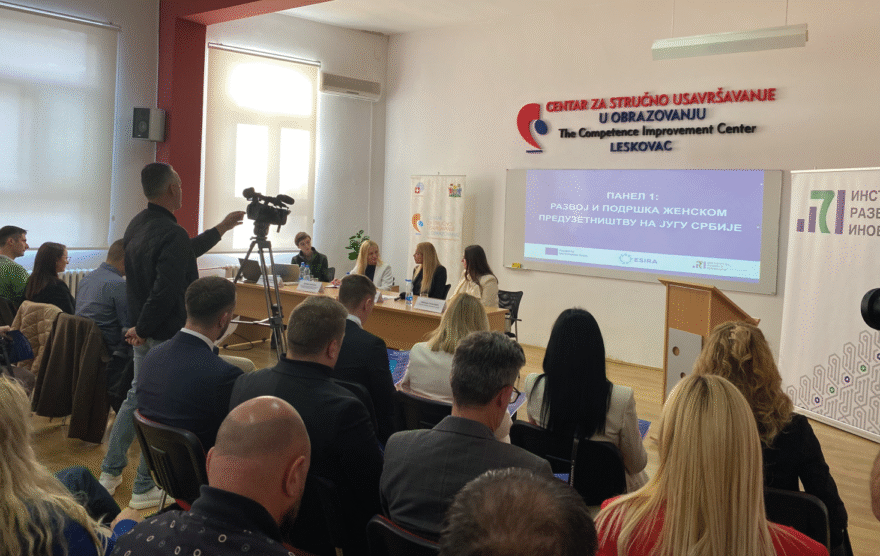
In Serbia, the districts of Jablanica and Pčinja were selected as pilot areas where a multi-actor platform was established with the aim of including as many local actors as possible and launching initiatives for the further development of this part of Serbia. Representatives of all local governments from this district took part, as well as representatives of the civil sector and regional development agencies.
The districts of Jablanica and Pčinje are below national averages in numerous economic indicators.
In southern and eastern Serbia, the average salary in 2023 was a quarter lower than the national average, while the unemployment rate is 3.5 percentage points higher than the national average. Certain population groups are particularly at risk, such as young people, where the unemployment rate is almost 23.4%, or women, whose unemployment rate is 14.5%.
The existence of a strong local community, through an established multi-actor platform, will influence the improvement of statistical indicators on the labor market in the future. Women, young people, long-term unemployed, and entrepreneurs – beginners in business – are recognized as the main target group of ESIRA project support in these districts, but this does not limit that local citizen initiatives can come from other areas as well, such as agriculture.