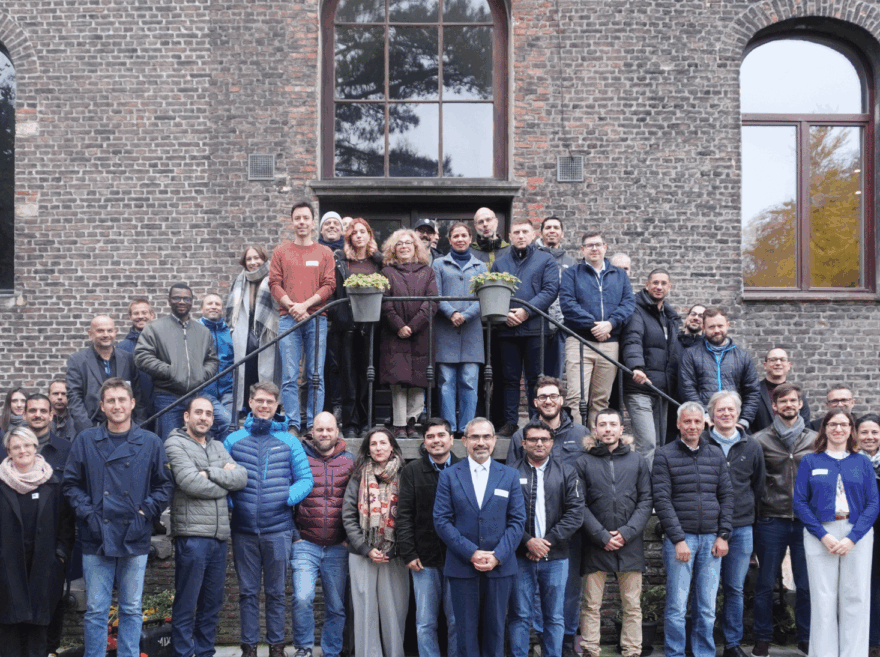
Тhe project RES2FIRE, full name: Models and Tools for Enhancing the Resistance and the Resilience to Wildfire in Natural Protected Areas and Wildland-Urban Interfaces, is a three-year project under the IPA ADRION programme, which is co-financed by the European Union. The period of implementation is from 2024 to 2027.
The project consortium gathered partners from 9 countries – Italy, Slovenia, Bosnia and Herzegovina, Serbia, Albania, North Macedonia and Greece aimed to develop joint solutions and coordinated measures for preventing wildfire risks. A budget of 1.2 million euros has been allocated by donors for the implementation of project activities.
The impact of climate change, such as rising temperatures, reduced water availability, and changes in rainfall patterns, is leading to increasingly frequent and intense wildfires. Forest fires represent one of the most serious natural disasters in the IPA ADRION programme area. They reduce forest cover, threaten biodiversity, and contribute to CO2 emissions in the atmosphere.
To overcome this problem, it is necessary to develop measures to increase the resilience and adaptability of ecosystems prone to fires. Even though at first this looks like a natural problem, the consequences of wildfire are beyond natural disasters.
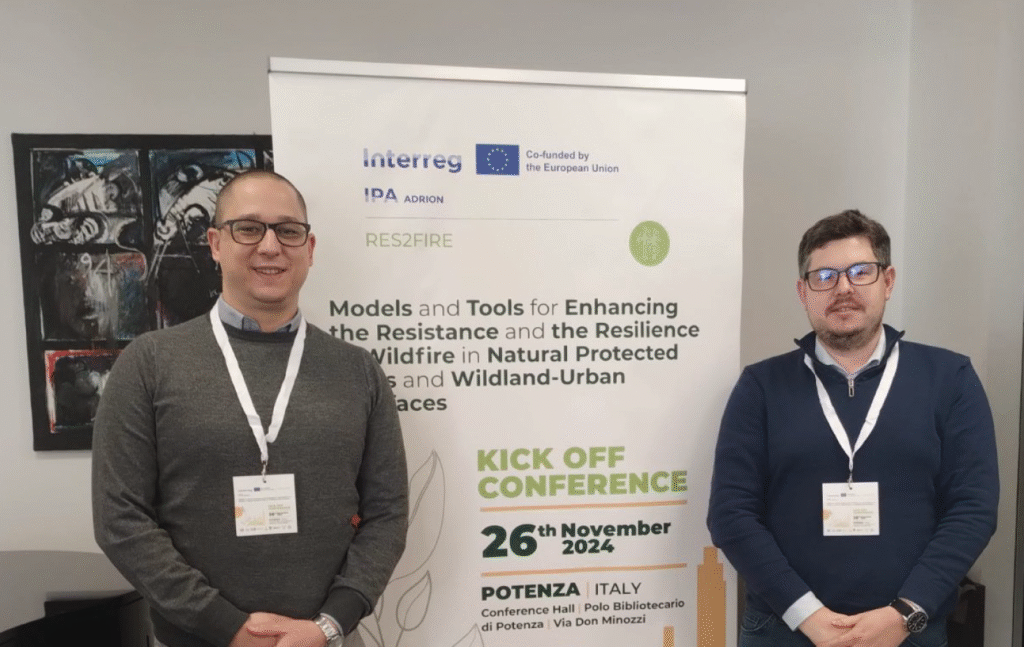
It also affects societies, especially rural communities in the IPA ADRION region. Hence, this problem demands a holistic approach in order to understand the size of the problem and develop an adequate solution. The project RES2FIRE applies a transnational approach and a “bottom-up” strategy, engaging a network of relevant factors such as national parks, forestry services, municipalities, and firefighting units. The focus is on sustainable and long-term solutions through cooperation and data harmonisation across the IPA ADRION region.
RES2FIRE aims to develop joint procedures, methodologies, and solutions for reducing the risk of forest fires and increasing ecosystem resilience. Project goals include the development of methodologies for mapping hazards and risks, establishing a network of stakeholders, pilot actions for sustainable forest management, identifying nature-based forestry models to reduce fire risks, a damage assessment model, a WebGIS tool, and an action plan for prevention and adaptation to climate change.
The financial consequences of forest fires indicate that they are a phenomenon broader than a natural disaster.
Within the project, the Institute for Development and Innovation will be responsible for all project activities carried out in the Republic of Serbia. Additionally, the Institute will play a leading role in preparing the Report on the assessment of ecological and socio-economic damages caused by forest fires. The Institute for Development and Innovation will closely collaborate with partners on all activities. It will contribute significantly to the creation of the joint network and dissemination of project results to decision-makers and other key stakeholders.
As part of broader efforts of the Institute for advocating for climate resilience, sustainable development, and data-driven policy development, the RES2FIRE project is in line with our other ongoing projects, such as DALIA, RURALITIES, and CLIMA PANNONIA, all of which address different dimensions of environmental sustainability and climate adaptation.
By participating in RES2FIRE, the Institute for Development and Innovation strengthens its role in regional cooperation, enhances its capacity to support evidence-based environmental policy, and expands its efforts in disaster risk reduction and green transition.